Ruby scares me #
Every time I take a look at Ruby, I am simultaneously intrigued and disgusted. Today I was looking at it once again, pondering the Camping framework for writing web apps, and ran across this explanation of how it works:
Behind the scenes, Camping actually reads its own source file (with the __FILE__ handle) and does a search and replace on all instances of Camping. It then evals the result and runs your app with the modified code!
— from O'Reilly's Ruby column
Argh!! On one hand, I feel like I shouldn't need to care how something is implemented. But I see this sort of thing (building and evaling code) so often in Ruby that it makes me worry that the language is incapable of expressing the abstractions that people actually want to build, and it might also be incapable of expressing the things I want to build. I guess I grew up treating eval as something to use only as a last resort. The only place I felt okay using eval was Scheme, where it took program trees instead of strings. Ruby still intrigues me though, so I'll probably try a project in Ruby at some point.
Labels: programming
An old classic: Settlers II #
Settlers II has been remade for its 10th anniversary. I've tried out the demo and it reminded me of all the things I liked about Settlers. The game is somewhat unusual. It's a building+war game, like Age of Empires, Tropico, Command & Conquer, etc., but its emphasis is on building and not on war.
One of the unusual features is the transportation model. In most games of this sort, people walk around wherever they need to go, and you can build roads to speed up their movement. In Settlers, you must build roads, and every road segment has a settler assigned to it. That settler will move goods back and forth along the road. You have to carefully plan your roads to handle the traffic; roads can become bottlenecks. Making road segments long means you use up fewer settlers and allows faster travel; making them short means you get a higher capacity. Roads also become paved and can have donkeys to increase capacity.
The transportation model changes the implementation strategy for the game. Usually you run a pathfinder (like A*) for each of the peasants, and combine that with a movement algorithm to avoid local obstacles. This can get expensive when you have lots of peasants. Each peasant handles a single type of good, usually assigned by you. For example, you might assign a peasant to be a miner; the pathfinder will find a path between the mine and the warehouse. There is no further distribution of goods; it goes into a global store that can be accessed instantaneously from anywhere. In Settlers, the peasants are not using the pathfinder. Instead, the pathfinder is used for materials and goods. They are physical objects that have locations and can move around. They can be put in a warehouse, but they have to be moved to the location where they get used. The peasants and road segments serve as capacity restrictions. If a good needs to move from one place to another and the road it needs to travel on is “full”, it waits for the road segment (and associated peasant) to free up. This works somewhat like a packet-switched computer network.
How do the goods “decide” where to go? A local approach would be to make each good perform pathfinding to its destination. Pathfinding on the road graph will be much faster than pathfinding on a grid, because there are far fewer segments and connection points. But how do they find their destinations? We could either keep a list of points that require certain goods, or we could build an influence map. It's possible with an influence map to not even need pathfinding. I'm not sure what Settlers actually does.
Another difference between Settlers and other building games is that the Settlers economy has much longer chains of production. Forests can be cut to produce wood. Wood are milled into wooden boards. Boards are used to build farms and other buildings. Farmland is used to raise crops, yielding grain. Grain is milled into flour. Wells produce water. Flour plus water is baked into bread. Grain plus water is turned into beer. Fishermen use fishing poles to catch fish. Hunters use spears to catch animals. Animals taken to the slaughterhouse become meat. Meat, fish, and bread are fed to miners. Miners can mine for coal, iron, granite, and gold. Coal and iron can be smelted into steel. Steel is taken to the metalworks to make tools such as spears, and to the armory to make swords and shields. Granite is turned into stone. Stone is used to make new types of buildings. Gold is turned into gold coins. Gold coins, swords, and shields are given to soldiers. Soldiers are needed at watchtowers, which expand your territory. The economy is complex.
Also unlike other building games, you don't control any of your people directly. You can indirectly control them by building things. To go to war, you need soldiers, but you never explicitly recruit or place soldiers; they are produced whenever you have enough of the needed goods (gold, beer, sword, shield). You can influence what gets transported by choosing a transportation priority for each type of good (this is like QoS for TCP/IP), and you can set the priority of having soldiers vs. builders.
At the start of the game, you don't need to worry about the full economy. For example, you can't build tools without steel, which requires coal and iron, which requires miners, which requires bread and meat, which requires grain and water and animals, which requires flour, which requires farms, which requires wooden boards, which requires wood. Instead, your initial warehouse includes many types of goods, from which you can jumpstart your economy. You don't need to make rarely used items like tools until later in the game, when your settlement is large. It's a nice way to gradually introduce complexity to the player.
It would be nice to be able to see general trends, like whether I'm building up more bread than I need, or whether people are perpetually low on water. It's hard to manage everything in your head by checking manually. If I were in charge of a town like that, I'd hire some people to gather information and alert me when something's wrong. Overall though it's a very interesting game, and not like other games I've played, so I think it's worth exploring.
Update: [2006-07-21] Sören M points me to a design document about transportation in Widelands (a game much like Settlers II).
Labels: review
A Tale in the Desert 3: First Impressions #
A Tale in the Desert is a rather odd game. It's a MMORPG based in ancient Egypt. There aren't any monsters to fight. Instead, you perform tasks like gathering, mining, farming, weaving, fishing, and so on. You use the materials you gather to make equipment, which you can use to make more complex materials and objects. Eventually you can build sculptures, buildings, and monuments. The game has a story to it, with a beginning, middle, and end. You and everyone else in the game is part of that story. The ending depends on the actions of all the players.
It's quite different from anything else I've seen. Although games like World of Warcraft have gathering and crafting tasks, the focus there is combat, whereas in this game, it's all about gathering, crafting, building, trading, and socializing. The tasks you need to perform can depend on what others have done. For example, you may need to build something larger than what anyone else nearby has built. Once you build it, your object remains in the world, visible to everyone. As I wandered around the game world, almost every object I saw was something created by a player. As a new player, I needed to find areas that weren't already occupied, so that I could set up the equipment I needed. Some of the basic resources (wood, sand, mud, grass, stone, etc.) are shared, so it helps if you set up a workspace away from others. As far as I can tell though, workspaces have a short lifespan, so you work in an area for a while and then move on.
The tasks you need to perform can also depend on other players. For example, you may need to build an sculpture and leave it out in the open so that passers-by can vote on whether it's attractive or an eyesore. Or you may need to talk to people and convince them of some cause. Or you may need to get people to join your guild. The social aspect is important; other people aren't there only to help you fight monsters. There's also the ability to propose new laws and get signatures/votes; if the new law gets passed, the game developers will implement it (remember LambdaMOO?). I didn't explore that aspect of the game.
The graphics aren't great, although they didn't bother me much. There's very little sound or music, and that hurts the game a great deal. Sound effects are incredibly important. The UI is awful. It looks like it was designed by programmers: there's lots of abstraction and generality, like scrollbars, arbitrarily sized dialogs, deep menu hierarchies, and an attempt to make everything vague so that it's reusable in other contexts. For example, to dry out grass and turn it into straw, you need to Drop the grass. This is “cool” in that it reuses an existing function, but I think the UI would be better with the task explicitly listed. The UI also offers very little feedback about objects and actions. There are lots of objects around. Some are usable and some are not. You won't know until you click and get a menu. There are lots of places where you can't do something, but it won't tell you that you can't until after you've attempted to do it. For example, when planting flax seeds, it allowed me to plant a second seed too close to the first, then it told me it was too close. Mark the area in red or something to give people early feedback about whether their actions are going to succeed. Don't let me do something that's not allowed.
Another problem with the UI, at least for a beginner like me, is that it doesn't really give you any hints about what to do. There's a huge list of tasks, but no way to learn how to perform them. For example, I was supposed to learn Carpentry. How should I do that? I have no idea. There's no tutorial as far as I can tell. I ended up going to the web and searching for the information. How was I to know that I should find the "SArch" building (whatever that stands for) and click on it?
I played for several hours and got through the ~30 starter tasks, with a lot of help from the web. That opened up new possibilities of projects I could do. However the game felt rather tedious and uninspiring. Let's see... I need 100 bricks. I'll collect mud, straw, and sand, then stand around for 10 minutes making bricks. Boring. There's no challenge in that. It's not interesting. It's likely that the social aspect makes up for it (the crowd I talked to was much friendlier and more mature than in any other game I've been in), but I didn't stick around long enough to find out.
Labels: review
World of Warcraft: First Impressions #
I've been playing World of Warcraft (WoW). It's the MMORPG to try. Last year I played around 250 hours of Guild Wars, but it's not really an MMORPG; it's somewhat like Diablo 2, which is multiplayer, but not massively so.
To get a good feel for WoW, I played over 50 hours over the past 10 days. I tried out 6 of 8 races (Alliance: Human, Night Elf, Gnome, Dwarf; Horde: Troll, Tauren), 6 of 8 character classes (Druid, Hunter, Paladin, Rogue, Warlock, Warrior), 4 of 12 professions (Mining, Skinning, Cooking, Fishing), and 1 talent (Marksmanship). I visited all 6 major cities (Stormwind, IronForge, Darnassus, Ogrimmar, Thunder Bluff, Undercity) and 3 of 4 Goblin cities (Ratchet, Gadgetzan, Booty Bay). I played mostly PvE, but also tried out PvP, both out in the open and in 1 of the 3 PvP instances (Warsong Gulch). I visited 1 of 36 PvE “instances” (Ragefire Chasm) and 12 of 40 major regions on the map (The Barrens, Durotar, Mulgore, Thousand Needles, Dun Morogh, Elwynn Forest, Westfall, Redridge Mountains, Teldrassil, Stranglethorn Vale, Tirisfal Glades, Darkshore). I tried out 1 minor quest from 2 special events (Midsummer Festival and Scourge Invasion).
Overall, I thought the game was well done. It's much more complex than Guild Wars and there are lots of different styles of play. Guild Wars offers character classes plus secondary classes, giving essentially 15 different combinations, although the choice of which class is primary and which is secondary gives each of those combinations two styles. WoW offers 40 combinations of races and classes. The races affect your appearance and give you bonuses and skills; the classes affect your clothing and give you bonuses and skills. Within each character, Guild Wars offers 4 attributes and plenty of skills influenced by those attributes; WoW offers attributes but also 3 talent trees and plenty of skills influenced by them. In Guild Wars, the attributes can be changed to suit each mission or area; thus, you don't have to choose which to specialize in. In WoW, attributes are influenced by race and class, but can be modified by items and spells. The talents are permanent choices, and thus you treat them like races and classes, and have 120 combinations of races, classes, and talents. So already WoW has a much richer set of choices (“builds”) in characters. But wait, there's more! In WoW, you also have professions, which are non-combat activities, such as Skinning (get leather or other materials from animals), Leatherworking (to turn leather into items), and Enchanting (to add magic to items). As you use the skill, you become more proficient in it, and that allows you to do more things with it (for example, when you are better at Skinning, you can skin from higher level animals). You can choose 2 of 9 main professions, plus up to 3 side professions. This raises the combinations of character builds to 4320, although in practice, only around 14 of the 36 combinations of professions make sense, so there are a “mere” 1680 character builds you might want to play. In Guild Wars, your weapon choices are largely determined by your character class. In WoW, they're influenced by class but you can learn to use new types of weapons. There are 16 types of weapons (such as Swords, Wands, Bows, etc.), and each character class starts out knowing some of them, and can learn up to 4 to 15 of them (varies by class). Once you choose a weapon, it increases the number of character builds to nearly 12,000. Compare that to 15 in Guild Wars and you'll get a sense of how rich this game is. I barely scratched the surface with what I tried out.
Each race has a starting location in the world. There are 8 races and 6 starting locations. This greatly increases replay value. In Guild Wars, there's one place everyone starts and explores, so the second time through you're not seeing anything new. In WoW, you can play 6 times and see brand new scenery each time. The WoW world is huge, varied, and non-linear; Guild Wars in contrast is fairly linear, much smaller, and has 5 types of areas (pre-Searing, post-Searing, jungle, desert, volcano). Different areas have monsters of different levels, so you can't venture in to the higher level areas without being killed. With several of my characters I did however manage to sneak by some monsters and get to high level areas, where one hit from a monster would kill me. There are special areas called instances. These are areas that are separate for each group of people playing. In Guild Wars, all areas other than the cities are instances; in WoW, most areas are not, so you can see lots of other people doing things unrelated to your party's actions (seeing other people is fun!).
There's just so much to do in World of Warcraft, and so many styles of play, that it's no wonder people spend huge amounts of time playing. There are also lots of repetitive actions that lead to variable results; this activates the gambling portions of the brain. For example, when performing quests to retrieve items, you will sometimes get the item and sometimes not; when killing monsters, you will sometimes get treasure and sometimes not; when fishing, you will sometimes get l fish (which can be eaten to gain health) and sometimes you will get treasure; when improving skills sometimes you will gain a skill point and sometimes not. Everything you do works this way; it's no wonder it's addictive.
The game was pretty smooth when it ran. Several times though the realm I was on would be down, and I couldn't log on. When I was on though everything was smooth and (as far as I could tell) bug-free. Blizzard seems to be pretty good at this.
I enjoyed the game but in the end I wasn't addicted to it (despite playing 50+ hours in 10 days). The main problem I saw was that the reward was far too low for the amount of time I spent. Running from place to place is really time consuming. At higher levels you can buy creatures to ride on, and this lowers travel time, but the reward is less pain rather than something rewarding in its own right.
The quests were often repetitive and boring. For example, I had a quest to go kill some ostrich-like monsters. It took a while to run out to that location and kill them. When I got back to town, I got a small reward and then was told to go out and kill some lions. I had to go back to the same area I was just in, kill lions, and go back. I was then told to kill some dinosaurs. I had to go back to the same area I was just in, kill dinosaurs, and go back. After that the series of hunting quests continued in a slightly different location with slightly different animals (zebras, more lions, more birds, and more dinosaurs). There were probably at least 15 quests like this. Another line of quests involved killing some variant of kobold, going back to town, then being told to kill a different variant of kobold in that same area, then going back to town, then being told to kill yet another variant of kobold in the same area. These kinds of quests really stretch out gameplay, because you have to run back and forth every time; you can't get get the next quest until you've finished the previous one. Occasionally the quest would be more interesting (for example, collecting dinosaur eggs while killing the dinosaurs), but it only seemed slightly interesting because the quests were boring.
I do like the whimsy in the game. There are lots of cultural references, silly items, etc. The dances are fun (for example, the orcs dance like MC Hammer). The graphics look cartoony, making the game feel more fun and less serious.
With the trial account I played, I couldn't participate in some of the interesting aspects of the game, like the auction system. In Guild Wars, you have to wander around, asking people for things to buy or sell. It's chaotic and it was so much of a pain, I rarely traded with anyone. With the WoW auction system, I think I would trade much more. Comparing trading in the two games really demonstrates how important efficient markets are. I also couldn't really get involved in guilds, which are apparently a lot of fun (but have high time requirements).
On my last day, I sold all my items and found that I had earned around 2.6 gold (26,000 copper pieces). This amount of wealth was unimaginable to me a few days earlier. The scale of wealth seems to go up exponentially. For example, a bag that can hold 8 items costs 4 times as much as a bag that can hold 6 items. Small increases in power come at a large increase in price. I think this is a good game design, but it felt strange to me. Despite getting so much, the last few days were just not much fun. Since I had only a short time left before my trial account was cancelled, I decided to kill off my main character in a most spectacular way. I went to the top of Thunder Bluff, the highest cliff I had found in the game, set myself on fire, and jumped off, to my death.
It's a very interesting and rich game. It's just not for me. It takes too much time and wasn't rewarding enough. If I were paying the monthly fee, I would feel like I had to play a lot to get my money's worth, and I'd end up playing even when it wasn't fun. The other problem I have with playing games online is that real-life interruptions can lead to my death in the game. If you have kids, you're going to have real-life interruptions. So I'll go back to playing Oblivion occasionally, and doing other projects (like writing a transportation game, going on scenic drives, and writing web articles). I do encourage people to try out the free trial (either from FilePlanet or by getting an invitation from someone who already plays), because it's an interesting game for game developers to study. I'm glad I tried it out. And I'm glad I didn't become addicted. :-)
Labels: review
Playing Oblivion #
In case you've been wondering why this blog (and progress on my game) has been quiet lately, it's because I've been playing The Elder Scrolls IV: Oblivion. It's a fun game, in part because the NPCs do their own thing, and it's fun to watch them.
Tonight I was running north along one of the main roads, and a bandit jumped out to rob me. He jumped a bit too late, for I kept running with a bandit on my tail. I met another bandit, who also started chasing me. I then met a third bandit and continued to run. I then saw two of them turn and start chasing a woman on horseback. She delivers the newspaper daily to all the cities. She screams and starts to flee downhill. I turn around and start chasing the bandits, not because I want to save her, but because I want to watch the chase scene. After chasing her down the hill to the bay, they noticed me and started chasing me instead. She fled to the south and I went to the north. I decided to escape by swimming across the bay. To my amazement, they started swimming too. I have a magic item that doesn't require me to breathe underwater, so I went underwater and hoped they would drown. They didn't. They periodically came up for air. As I reached the other side of the bay, I looked down and saw the two of them coming up for air, then diving again. I wasn't able to escape.
I decided to turn east and head for a fort. Many forts contain monsters, and these monsters often fight humans, including bandits. Not all of my enemies are friendly towards one another. At the fort was a troll, a mudcrab, and a bear. I jumped up to a high perch and watched the two bandits defeat the three creatures. I then decided to lead them to a nearby cave. Along the way the bandits killed a wolf, and at the cave they met a minotaur and an ogre. In Oblivion, ogres are incredibly strong. It was here that I expected the bandits to meet their end. Instead, they fled! They swam across the bay, out of my trap.
I chased the bandits across the bay. I lost one of them, but saw the other one run up a hill. I chased him for a while but eventually he got away. I went back across the bay to the minotaur and ogre, and led them to a nearby goblin cave. It took three goblins to kill them. Now I have one goblin remaining. I took him to another cave, inhabited by a rival tribe of goblins. Four goblins from the rival tribe killed the one goblin I led there. I now had four goblins chasing me. So I took them back to the first goblin tribe's cave. I kept running back and forth, not actually fighting, but just leading goblins to each others' caves, and the hordes wiped each other out.
Playing this way is amusing.
Having played for 130 hours, I'm about halfway through Oblivion. It's an interesting game for a game programmer to play. You can guess what techniques they used for their AI, and then run experiments to see what happens. I'm probably not playing the way they meant the game to be played.
Labels: review
Do people really want innovation in games? #
People seem to complain that games (and movies) are all the same—that there isn't enough innovation. I suspect though that people don't really want innovation. Guitar Hero is innovative. Wii is innovative (watch the Wii video from E3). But if you enjoyed some game, don't you want more like it? Or would you rather take your chances with something random?
In the field of machine learning, there is the notion of exploration vs. exploitation. As you learn things, you want to take advantage of what you've learned. If you never exploit what you've learned, why bother learning it? Why bother learning to read if you're never going to read? However you can't only spend your time doing what you know. You also want to spend some of your time exploring new things. Otherwise you may not discover something better than what you know. 100% exploitation is a mediocre strategy. 100% exploration is a bad strategy. You really want some of each.
In game development, movies, books, etc., it would be a shame if there were no sequels or games similar to existing games. That would mean that if someone discovers something good, we never do that again. On the other hand we don't want only sequels. I think games like Guitar Hero, Gish, The Sims, Everquest, and Puzzle Pirates demonstrate that there is innovation out there. Some people are arguing that there isn't enough. Others are arguing that there shouldn't ever be sequels. It's hard to know what the “right” amount is. I do believe that the way the free market works, there will be slightly less innovation than is optimal. It's not zero though. And I don't believe that you can force the market to innovate more. Ironically, a market with lots of small independent game companies is likely to produce less innovative games than a market with behemoths like EA. But that's a story for another day.
I find that of the games I've gotten recently (Black and White 2, The Movies, Guild Wars, Oblivion), I've enjoyed the innovative games less. I think that's because the sequels have more refinement in them, and that makes them better than the innovative games, which haven't been tried out on a large scale and don't yet have the feedback needed for improvement. I'm trying to spend around 10-20% of my time playing innovative games, in part because I like to study them as a game programmer, but also because I want to spend some of my time exploring new things.
Innovation isn't dead. It just produces lots of junk, which is what it should do. If all innovative games are good, people aren't experimenting enough. Sequels aren't bad. If we never had sequels, we'd never be able to polish the rough gems found in the innovative games.
Labels: design
Prediction, Chaos, and Order #
When you play a game, can you predict what's going to happen? I think being able to predict everything makes the game boring. Being able to predict nothing makes winning unrewarding. It becomes a game of chance rather than a game of skill. It's games in between that I'm interested in.
I want skill to be important, so that winning is rewarding, but make each instance of the game different, so that you can play repeatedly. How can you make the game somewhat unpredictable?
- Multiplayer. If you add other humans, and humans are hard to predict, then we can't predict the outcome of the game. I think however that this isn't sufficient. If the opponent is good and the game predictable, you can predict what the opponent should do. Tic-Tac-Toe is an example of a game that's multiplayer but boring.
- Complexity. In some games, the game world is so complex that a human cannot accurately predict what will happen, even if everything were known. Chess is an example of a multiplayer game in which the entire game board is known, but it is not possible for a human to determine the best move.
- Randomness. If some aspects of the game are random (for example, the roll of the dice), the game will be different each time. If there's too much randomness, then the winner is essentially random. If there's too little, then each game will essentially be the same. But if you get it just right, then the player's skill demonstrates how he reacts to the game. There's also randomness in physical games. For example, when playing golf there's some randomness in where the ball goes, just from unpredictable variation in the stroke, and factors like air density and wind.
- Information Hiding. Some information about the game world can be hidden from the player, and the player's skill can be used to infer aspects of the hidden information. You can hide the initial game world (for example, the cards initially dealt to each player), the opponent's moves (for example, the cards discarded by an opponent), or the result of randomness (for example, the cards drawn from a shuffled deck during the game).
Many games combine more than one of these. For example, Chess combines complexity and multiplayer. Poker combines information hiding, multiplayer, and randomness. Civilization combines all four.
When playing a game that involves randomness, it is important to note that skill is not the only factor; “luck” matters as well. In the NCAA tournaments starting this week, as with all sports games, you cannot conclude that the winner is a better player. You can only conclude that the winner is likely to be a better player. That's why rematches are useful—they let you be more confident in who's better.
My transportation game involves randomness and complexity, and I am undecided about information hiding. It's a single player game, and I am not planning multiplayer. After all, I will be the only player.
Labels: design
Transportation game, models #
I'm trying to use stocks and flows to create a model for my transportation game. Stocks correspond to nouns and flows correspond to verbs. At first I thought businesses would be stocks and the transportation of goods would correspond to flows. But I could also see the businesses as flows (since they consume and produce things) and the cargo areas and trucks as the stocks. Or maybe both trucks and businesses are flows, and only cargo areas (loading docks) and warehouses are stocks. Or maybe the cargo itself is the stock.
When it comes to a game, the player's decisions (and the AI's decisions) can directly affect flows, but not stocks. You can change the rate of production in Warcraft by hiring more peons, researching technology, etc. Production of gold is a flow. You do not directly change the amount of gold you have (except by buying something, but I think that's an instantaneous flow). Gold is a stock. There's no decision to be made with a stock—it just exists. There is a decision to be made with each flow, because you can throttle it back from its maximum. There are other decisions to make as well, but the basic resource management decisions (for gold, wood, soldiers, etc.) are about flows, not stocks.
In my game, the player controls the movement of trucks and the AI controls the businesses. The decisions are based partly on how much of each resource is available. I'm planning to treat trucks as stocks and the loading/unloading of them as flows. Businesses will be flows, but their cargo areas will be stocks.
The transfer of cargo is not enough to make an interesting game. The player will also need to make decisions about infrastructure and placement of transportation systems. The actual loading and unloading of trucks is boring; it's likely that an AI agent, acting on behalf of the player, will make those decisions. I still don't have a clear idea of where I'm going with this game, but it's already led me to some interesting topics (operations reseach, system dynamics, supply chain management).
Labels: project
Impolite game: Spellforce 2 #
I no longer play Guild Wars, Black and White 2, or The Movies, so I've been looking for another game to buy. Battle for Middle Earth 2 and Spellforce 2 both looked interesting, so I downloaded their demos.
Spellforce 2 won't start the demo unless I install StarForce. What's the point of copy protecting a demo? And worse, StarForce is awful and I am not buying games with it. So Spellforce 2's demo goes into the recycle bin, and I'm trying out Battle for Middle Earth 2, which looks and sounds nice. It seems to use SafeDisc, which is perhaps not as bad as StarForce, but still annoying. It also has lots of splash screens that can't be aborted by pressing Esc or Enter or Space or by clicking the mouse. Why do games tell you to use NVidia/ATI and Intel/AMD? Do they really want to tell 75% of their audience that they've chosen badly? I haven't found a major commercial game as friendly as Guild Wars. Fortunately Guild Wars is about to release an expansion pack, so perhaps I'll wait for that.
Labels: review
Transportation game, basic objects #
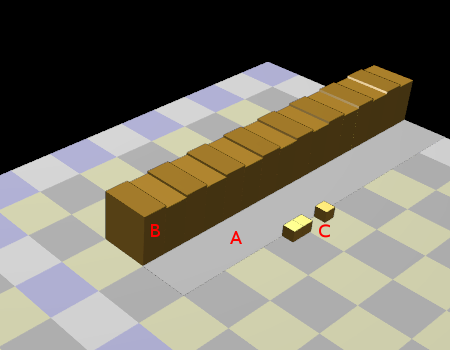
I wanted to start with something simple for my transportation game. I want to explore the transportation of goods between businesses. I created a simple model:
- Business. Each business (labeled B in the diagram) can consume and produce items. For example, a steel mill consumes iron and produces steel. Some businesses only consume; some only produce. In my initial implementation, there is only one producer (a dock, where goods are imported from other areas) and one consumer (a retail store, where goods are bought).
- Cargo. The goods and materials are put into containers (crates, boxes, pallets, etc.) and the containers (labeled C in the diagram) are moved around the game world. Each container represents some amount of material or goods. In my initial implementation, there is only one type of cargo (“goods”) and only one size of container.
- Loading Areas. A business may not consume goods as soon as they arrive, and it may produce goods that are not immediately picked up. Loading areas (labeled A in the diagram) are a place for cargo to be stored.
I haven't yet chosen good terminology. Is it business or building? Is it cargo or container or goods? Consistent use of terminology will help in picking good names in the code. I want to choose names that are general enough to cover a wide variety of cases.
I think the model has some nice properties. It's very general, so it can apply to many different kinds of businesses. For example, a warehouse is a business that produces the same thing it consumes, and consists almost entirely of loading areas. The loading areas make it easy for the player to see when the transportation system is working too fast or too slow. However, there are a lot of unanswered questions at this point. Does each type of cargo require its own loading area? Does a business buy from just anyone or does it choose its suppliers? How are perishable goods represented? I will leave these questions for later and focus on the simple case: one producer, one supplier, one type of cargo.
Labels: project