Changing a URL #
One of the things I highly value is stable URLs. When you link to my site, I want that URL to work as long as my site is up. I don't want to lose all those links lightly. But for ease of implementation, the URL structure matches the file structure on my site, and I occasionally want to change the file structure. So what should I do?
I make a 301 redirect from the old URL to the new URL.
There are links on forums, discord, stackoverflow, etc. that I can't expect anyone to change. But I can keep those links working on my end by adding a redirect. I have made 28 of these URL changes in 28 years, an average of once year, and each one has a redirect to keep the old URLs working.
Labels: infrastructure
Website updates, part 3 #
While updating my website build process over the past week (part 1, part 2), I decided I should also revisit my page layouts. Last year, I started learning about responsive design, studied the theory, and implemented it on my site. I converted 514 out of around 600 pages, and said “The rest are either unimportant or impractical to convert.” Of the ones I didn't convert, some were in a 450px width and most in a 600px width. I wanted to see if I could convert the 450px pages to 600px at least.
Labels: design , infrastructure
Website updates, part 2 #
In part 1 I described some of the things I was doing to improve how my site is built. I had planned to implement the translation of each XHTML file to HTML in Python, but that didn't quite work out. I went back to my primary goals:
- Versioning of references to JS, CSS resources, so that I can improve browser caching of my pages.
- Tracking dependencies so that if something a page depends on is modified, the page is rebuilt.
- Custom macros for each project.
I was hoping to implement all of this in November before I started my December project, but I didn't. So I decided to focus on the most important part, versioning.
Labels: infrastructure
Website updates, part 1 #
I finished mapgen4 last week and wanted to "sharpen my tools" before I started the next project. My website is over 20 years old and spans 5 domains. The build process has grown over time, supporting all the different tools I've used over the decades.
There are a few features I've wanted to add to my static site generator:
- Versioning of js, css resources so that I can increase the expiration cache time. This should improve load time. I've been doing this manually and want to automate it.
- Dependency tracking, so that if something includes another thing, and that thing changes, the first thing gets rebuilt. This should reduce content mismatch errors.
- Custom macros for each project that get expanded at build time. This should make it easier to write new pages.
Labels: infrastructure
Website updates, part 2 #
In my last post I said I was going to update my website layout. I've been working on it for the past three weeks . The main change is responsive design: the page will adapt somewhat to the size of the browser window, including phone and tablet sizes.
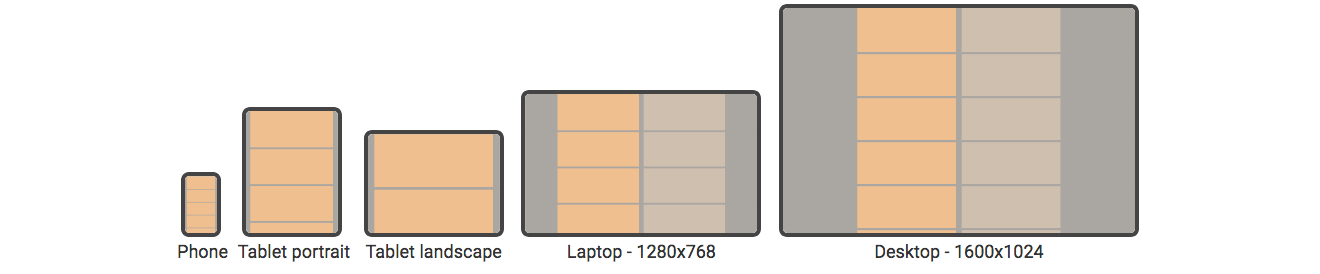
Of approximately 600 web pages, I have 514 converted to the new layout. The rest are either unimportant or impractical to convert.
To help myself understand the issues, I made some diagrams:
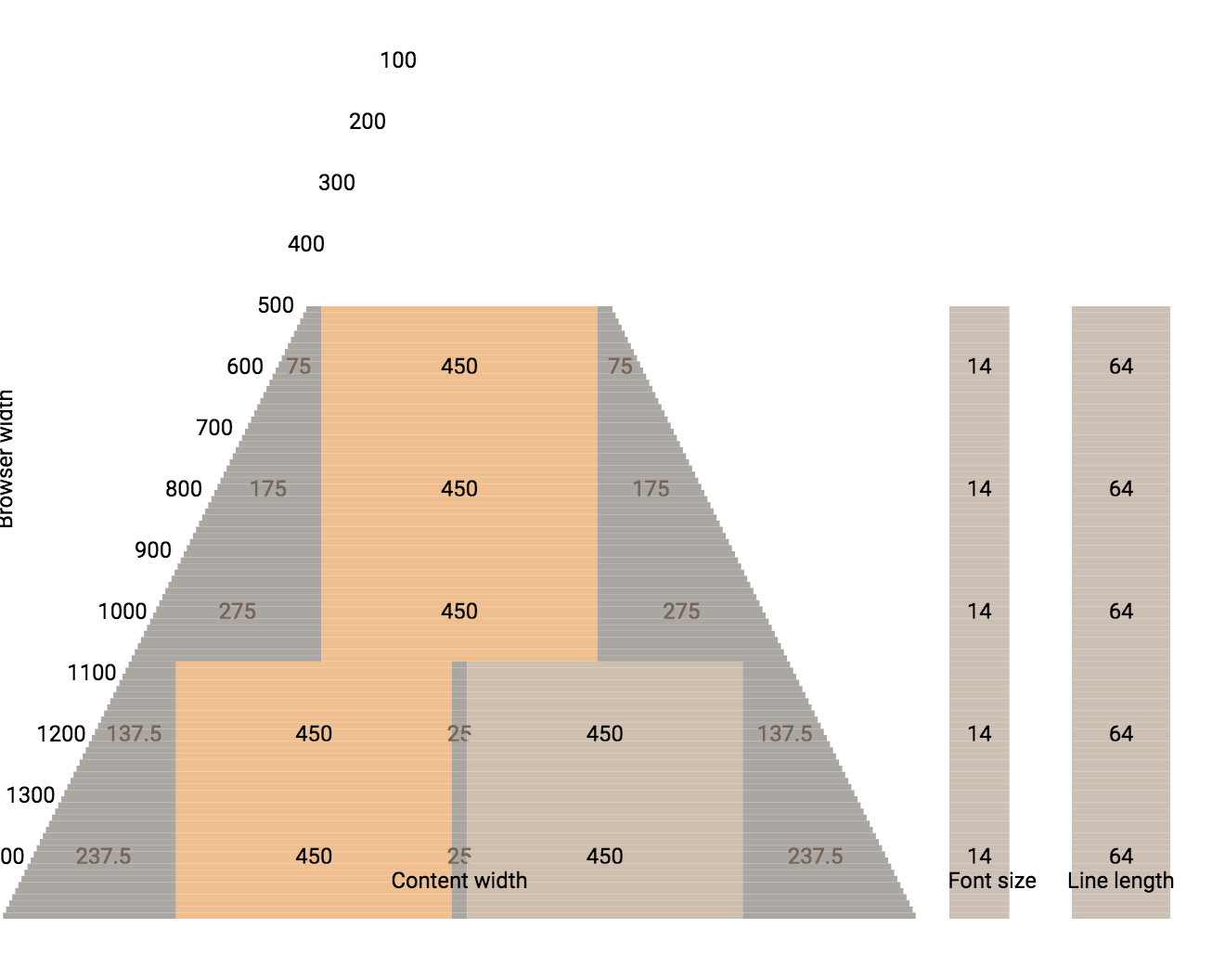
I wrote up my notes about how I made the pages responsive.
I also fixed some glitches on my pages, and switched from downloaded fonts to system fonts (to make the page load faster).
For testing, Firefox's screenshotting tool and Chrome's screenshotting tool were both useful. I took screenshots before and after a change, and then reviewed the pages when screenshots changed.
# Firefox
/path/to/firefox \
    -screenshot \
    --window-size=$width,4000 "$url"

# Chrome
 /path/to/chrome \
     --headless --disable-gpu \
     --window-size=$width,4000 \
     --screenshot "$url"
Labels: design , infrastructure
Website updates, part 1 #
For the most part my website setup has been the same since 2011 when I launched www.redblobgames.com. It's a static site served by nginx. I'm currently working on two updates:
- I'm (finally) setting up https. This has been more of a pain than I expected.
I think I have OSCP working. I didn't set up ECDHE but may have that. I didn't set up DHE or ECDH. No POODLE or BEAST. Somehow got P-256. I have PFS. I'll do HSTS later. Didn't set up HPKP but it may be obsolete anyway. Can't set up CAA with my DNS provider. No RC4. I have ALPN, NPN. I have CORS. Don't need SRI. I have XFO and XXSS. I have CSP but don't like it.
I have acronym overload.
I'm also updating my internal links to link to the https version.
- I'm (finally) learning responsive design.
I have pages going back
2722 years and I've been making layout changes less and less often. Every time I change something it takes a while to go back through all my pages to make sure it works on all of them.My older pages like polygon map generation are designed for a
400450 pixel width. I had designed that layout to support desktop computers back in the 1990s. As I worked on more visual pages the400450 pixel width seemed limiting so I designed newer pages for 600 pixels. For mobile, I told the phone to treat the page as 640 pixels wide, and scale it to fit. I haven't updated that layout in years. I experimented with wider layouts for the probability page and the hexagon page (both pages switch to a two column layout when the browser is wide enough) but for the most part I've tried to stick to the 600 pixel width. It's simple. It works.In the past few years browsers have quickly added features like flexbox, grids, calc(), scaling of images, and high-dpi. I've seen some neat layouts using these features, and it would let me do several things I've wanted to do but couldn't figure out. I want more flexibility in my page design than a single 600 pixel column. Lots to learn!
I'm also strongly considering dropping custom fonts. I don't think they're adding that much right now, and they slow down page loading. I'm also considering using serif. Back in the 1990s serif fonts were a poor choice, as screen resolutions weren't high enough to render them nicely. But today? After a decade of 1024x768 there's been a sudden increase in screen resolutions / density, so I should consider serif fonts.
Labels: infrastructure